Sunday, April 12, 2009

A Week in the Field


I have just returned from spending 7 days at the ECO-V field station on the edges of Udawalawa National Park. The experience was a fantastic chance to see first-hand the work done by the Pelican Project team, and to get a close look at the realities of working within a rural community.


Staying at the ECO-V field station in Udawalawa village, just outside the park, I was hosted admirably by Harsha, Mananperi, Bandara, and Ajiith. They were able to show me all aspects of the project as well as many of the local sights.


I was taken to tanks where observations on pelicans and other wildlife had been carried out by the team. These wetlands are a haven for all sorts of wildlife - particularly birds, but they are also imperative for the livelihoods of the local fisherman. This is something I was able to learn more about with a fascinating visit to a carp breeding facility run by the fisheries authority.


Fishermen rely on a healthy environment


One thing that was never far from view was the invasive plant species lantana (Lantana camera) - seemingly around every corner. It provides a massive problem for the growth of native plant species and also reduces the available grazing for elephants.


Lantana dominates the foliage, often growing to obstruct vehicles' access in the National Park


Therefore, encouraging the growth of native plants is an important step, and the Pelican Team have been busy growing and planting saplings that will hopefully grow into suitable trees for pelicans and other birds to roost and nest in. We visited one tank where saplings were starting to take hold on the banks, and it was nice to dream that in a few decades time young pelicans could be fledging from these trees.


Seedlings in fabric bags prior to planting by a tank


A small sapling looking strong on the shore of a tank


The successes of the tree-planting scheme will, like all initiatives in this area, be dependent on the community’s support - which the team has been so careful to mould.


I was able to meet a fishing family that had benefited from the provision of a sewing machine. This lady, with ECO-V’s guidance has been able to produce fabric bags as an environmentally friendly alternative to polythene. These bags are now becoming popular within the village, and are proving to be an important part of upholding the status of the project within the community.
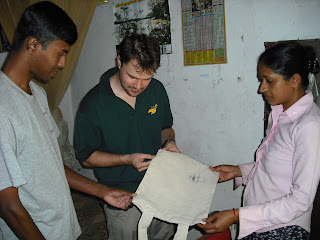

Investigating the handiwork


The foundations for the future community support are being laid through the development of the Friends of Pelicans group. Whilst in Udawalawa I attended a Friends of Pelicans meeting, which was hosted by Harsha. I was able to see how keen these young people were to be involved - another positive sign that the area is in safe hands.


Harsha with some of the Friends of Pelicans


Throughout my stay, I was struck by the level of friendly respect in which the team is held throughout the community, and it was clear that the careful, often slow, steps that have been taken to ensure local support for more eco-friendly activities have been worth the effort.


Walks around the surrounding area gave me opportunities to see the landscape that these local people live in and rely on. The waterways, the paddy fields and the plantations are all delicately reliant on many factors remaining favourable. The community now recognise the importance of saving the pelicans, and a healthy pelican population should mean a healthy wetland system and a more robust resource for the local people.

Surviving on the land can be tough


Of course, being situated on the edge of a national park offered many wildlife viewing opportunities, both inside and outside of the protected area. One morning, we went on safari within the National Park, coming close to countless elephants, saw buffaloes, monkeys, monitors, crocodiles, hornbills, bee-eaters, storks, herons, and spot-billed pelicans. It was breathtaking and unforgettable.

One of many magnificent elephants seen on the safari


Add visits to temples and sites of other cultural interest in the area, a swim in the reservoir, the chance to get to know the project staff better and it all combines to make a very special week - and a valuable insight into the nature of the challenges being faced and met by the Pelican Project team.

Sunday, March 29, 2009

Successful Step with New Udawalawa Community - by Mark Chappell

On Friday, I joined a number of the ECO-V team on the first field visit of my stay in Sri Lanka.

After a four hour mini-bus journey through some beautiful countryside, we arrived at a tank (a man-made reservoir created for irrigation) near to Embilipitiya, close to where ECO-V has been working with many communities.

This tank suffers from a familiar problem - the encroachment of invasive plant species. Specifically, non-native, fast-growing plants, such as water hyacinth (Eichornia crassipes) have colonised the bank - meaning that the effective surface area has been greatly reduced - which has an adverse effect on the tank’s spot-billed pelicans. Complete eradication of these introduced aliens would be almost impossible and, despite causing certain problems, the new plants provide some excellent habitat for other native animals.
Water hyacinth and invasive reeds have created a new “bank”. In the distance, the trees indicate the historic bank.

The changes are not so good for the local fishermen who rely on the tank for their livelihoods - the reduced surface area creating greater competition between fishermen. ECO-V had identified that this group are crucial allies for the protection of this wetland, so a careful period of approaches and informal discussions over many months had led to this hour-long meeting between ECO-V, the local fishing association, and a representative of the local waterways authority.
Under the cover of a shelter situated between the tank and the road, we sat on chairs (that had been brought on the back of a motorbike) in a circle.

It was fascinating to watch the meeting unfold. Bearing in mind that during the meeting I had no idea what was being said (it was conducted entirely in Sinhala), I watched as the fishermen and their families were encouraged to passionately share their experiences of the gradual deterioration of their fishing fortunes.

They were then told how, with ECO-V’s help, they can expand their utilisation of the tank. Through ECO-V’s contacts, they can learn to sustainably harvest some of the bank-side plants and develop ecotourism tours - making the most of the fantastic wildlife viewing opportunities. This diversification of income would make them less reliant on access to the fish.

I could tell that the meeting had been a success (even before the subsequent English summary) by the smiling faces of all involved. Expressions of thanks were given: despite knowing that things were wrong with the tank, the fishermen had previously felt powerless to act.

By developing a good relationship with the fishing community, any initiatives to control the invasive plants in the future hopefully will be supported. And through eco-tourism, the fortunes of these stakeholders will be dependent on the maintenance of high biodiversity around the tank, so this habitat should have a greater prospect of being maintained.

After the meeting, we were given a first-hand glimpse of this variety of wildlife as we were taken around the tank in fishing boats. We got close to a great variety of water birds, and you can see photos of many of these by clicking on the link to the Flickr photo stream on the right-hand side.
Pleased that the day had seen a successful step in the conservation of this wetland, we made the long trip back to Colombo - happy and exhausted.

Mark

Monday, March 23, 2009

Sri Lanka and ECO-V: A Volunteer's Perspective


My name is Mark Chappell, and I am visiting Sri Lanka from the UK for a couple of months, assisting ECO-V with a number of activities.

I will be writing a number of contributions to this blog during my time in Sri Lanka, offering a different perspective on ECO-V’s work and my impressions of the island. 

On Thursday morning I arrived shattered, but the friendliness, colour and bustle had me wide awake and desperate to take everything in. The assault on the senses has continued and I think it is fair to say that Sri Lanka has complete hold over me already. 

The ride from the airport almost didn’t last long enough - I was desperate to absorb my surroundings. However, I was glad that I didn’t have my driving licence with me - I’ll happily leave that fun to those who know the “rules” of the Sri Lankan roads.


The setting here at the ECO-V headquarters is superb. Not far from the activity of Colombo, yet surrounded by greenery and wildlife. Shortly after my arrival here I was able to spend a few hours on the balcony, watching the wildlife that spills over from the nearby nature reserve, and soaking up the sounds of insects, birds and frogs. 

Things started to happen from about 6pm - the sun was dropping quickly in the west, and birds started to head home to roost. This was great, but the best was yet to come. As it got darker, one, then a few, then hundreds of flying creatures appeared from the direction of Colombo city. Indian flying foxes (fruit bats) headed towards their feeding ground, and flew straight over my head. Thankfully, there were no falling guano incidents! It was a breathtaking sight.

The hospitality has been fantastic, the surroundings inspiring, the food delicious and I know that I will have a terrific and constructive stay in this amazing country.

Mark

Saturday, March 7, 2009

First field visit to the forest of Kalu Wandura

After having several visits to Forest department finally we got the permission for entering the forest to observe the Kalu Wandura. We are grateful to Professor Sarath Kotagama for his assistance in getting us the permission. Mr Yalegama the new RFO for Waga forest department office was very helpful in getting us an officer to guide us in the forest. So I made a visit to the forest with my team in searching Kalu Wandura. We only did able to see 3 individuals and heard several calls. However it was a very successful field visit as we got an idea about the forest habitat and saw many birds including a Three-toad kingfisher. Now the team members are visiting the forest daily to habituate the langurs before we start their feeding behavior.

Last week was very busy one for me as I was writing proposals, making progress reports and also getting ready for the annual exhibition (March 26-28) at Pelican Conservation Project. We also confirmed the dates for Kate Stork Memorial Training programme (From 1st – 4th of May) for “Friends of Pelicans”.

Former Deputy Education Manager of Durrell (Jersey Zoo) Mark Chappell will be visiting us as a volunteer to ECO-V on 19th March. He will be helping ECO-V in the exhibition, training programmes and also will be conducting a workshop for Field Ornithology Group of Sri Lanka.

ECO-V 8th anniversary


We proudly celebrated our 8th anniversary on the 7th of February 2009. However due to our busy schedules we had to wait until 1st of March to have our annual get-together. Last Sunday our members came to our office to participate in the annual “Thiresi Hamuwa”. Participants included Kalu Wandura Conservation project team, the Pelican Conservation project members and some of our pioneer members who formed External Action Committee of ECO-V seven years back. Harsha presented the progress of the Pelican project while Devaka briefed the Kalu Wandura project activities to the general membership who were present .I too presented the activities and achievement for past eight years and discussed the future activities of ECO-V including volunteers role in ECO-V. All were served with traditional sweets and tea after the meeting.Finally Ramyanath conducted a short guided tour to identify the wild flowers of Sri Lanka. This was highly appreciated by the members as it was a new experience for them. Everybody enjoyed the view of the Bird sanctuary while having tea on the top floor of our home.

Tuesday, February 24, 2009

ECO-V helps children to go to school in 2009.


At the beginning of the year 2009 we got a request from Major. Danaranjana from Sri Lanka Army to help some school children to go to school. Major Danaranjana has been helping us since we started working in North Central Province in 2004. Therefore, I did not want to think twice about that humble request as we have previous experience in carrying out project like this with is coordination. Beginning of 2008 we helped 62 children to go to school. This year we had a very short period to work on this as I was getting ready to go to India. Therefore I only send an email to some of my friends and relatives mentioning about the requirement of making school packs. With the help of them and their contacts we were able to make 25 school packs which included a school bag, book, colour pencils, pastel, pens, pencils and a pencil case. A friend of Yasas donated all the school bags needed and we bought enough exercise books for 25 children. Major Danaranjana took the responsibility of transporting and distributing the packs to deserving children in Ampara area. Last year our donation went to Padaviya area but this time he has found more deserving children in Ampara area.

However, I still did not get the photographs of the event but Major Danaranjana phoned me several times and described how it went on. My team at Kalu Wandura conservation project personally took the responsibility of going to Pettah and buying all the items for school pack and Yasas’s friend has arranged to deliver all the bags to our office. ECO-V thanks Jayani, Ramani, Madhubahshini, Jeevan, and Yasas for their helpfulness and thoughtfulness for our sons and daughters of Sri Lanka with their generous contributions. Photos attached here are taken when my team was making the school packs at our office.

Wednesday, February 11, 2009

Kalu Wandura team in the field!


On the 23rd of January Kalu Wandura project team, Devaka, Ramyanath, Tharaka, Indika and Chatura went to Waga field station with all the equipment. Harsha was also there with them as an experienced ECO-V member as he was very successful in developing Udawalwa field station two years ago. They were busy whole day cleaning the house and getting ready for next day till I went to have the house warming ceremony. I went to Waga along with my family (Thushara, Boo, Nipu and my mother) next day morning. We all met at the Waga Kahahena temple and met Ven. Kahahena Sri Medananda thero and got his blessings. He was the main person helped us at the beginning when we conducted Waga exhibition on kalu wanduara. Jaliya and Srinath (whom Dr. Rudran trained last October) were also there as they were villagers of the adjacent village to our field station. We had a field visit to the forest entrance but did not enter to the forest as we still do not have permission from the Forest Department. We recorded many fish species and birds from the surrounding area leading to forest and all team members are exited about the work.

Next few days kept us busy on getting permission and making plans for the community survey. Mr. Danasekara, Manager of the Pussella Plantations and Mr. Indika, Grama Niladari of Lahirugama, Welikanna were very helpful in finding the field station and always look after our need now.

Finding solutions and mitigation methods of Human/Kalu wandura conflict and safeguarding its survival are the challenges ahead for us. We hope to achieve it slowly with the commitment of the young team of “Friends of Kalu Wnadura” we are going to form in Waga area.