Friday, July 10, 2009

Kanchana is back with Pelicans and Langurs!


I came back from Netherlands after a very successful 3 weeks training course at Wageningen International. It was very difficult to say good bye to training mates as all of them were so friendly and interactive. I think I learnt a lot from them and the course helped me to develop my teaching skills as a trainer and a facilitator. Two Dutch course coordinators; Esther and Ingrid were very helpful and have done a great job in sharpening my skills. I am sure every one who participated in the course was able to get the maximum use of the training. Sri Lankan way of Greeting “Ayubowan” (May all living beings live long) was accepted by everybody as the best way of greeting and all the time we were using that. David my friend from Ghana (see the photo, me and David saying Ayubowan together) particularly wanted to use it for his teaching.

The most interesting thing was meeting one of my good friends after 10 years . Tahir Shawl whom I met at the International training Centre in Jersey Zoo, UK (Durrell) in 1999 was also there in this training and it was a nice surprise (See the photo, me and Tahir). We could not stop talking about our training at Durrell 10 years ago and all our training mates were surprised to hear that we have met long time ago. Tahir is working as a wildlife park warden in Jammu & Kashmir area. I can remember my good friend Robyn Dalzen from CLP programme has mentioned in one of her emails that she was told “The world is very big, but all the nice and interesting people know each other.” So I also agree with that. All good and enthusiastic people in the conservation world seem to be end up meeting again and again and the bond among them is so strong. There are lot to share with each other and I am sure we can make a difference if we keep working as a real nice big family. So my dear 42 training mates, Esther and Ingrid you are so important to me and I miss you all! (See the photo me with Lakshmi the training assistant, Esther and Ingrid). Thanks to Netherlands fellowship Programme for sponsoring me to attend the training.

Soon after I came back I had to start working with the “Kalu Wandura” (Leaf langur) Project. Dr. Rudran who was in Sri Lanka just before I went to Netherlands has given many instructions to the team. We were waiting for him to come to Sri Lanka as the team had never met him before. So it was good to have him here and get his advice to improve the quality of the study. Harsha my colleague has done a great job as an overall coordinator to ECO-V in absence of me.

Friday, June 19, 2009

Kanchana in Netherlands


I found a time to write something about our work in the middle of a training of trainers of wetland Management (TOT) in Wageningen, Netherlands. I came here on the 7th of June and will be getting this training until 27th of this month. This is going to be a very useful training for me as well as for ECO-V as we are currently working on Pelican’s habitats in Sri Lanka. We started on protecting Spot-billed pelican habitats after our work on distribution of Spot-billed Pelicans within Sri Lanka .We realized that their habitats; fresh water man made tanks are in real trouble mainly due to siltation and aquatic alien invasive species. Many fishermen in the freshwater tank habitats are complaining about not taking any actions for this habitat degradation and according to our experience its not that they are not aware of what is happening but they are not stakeholders among the responsible authorities. So ECO-V decided to bridge them and do what ever we can do to protect the pelican habitat for both human and for wildlife. Therefore this TOT will be very useful for our future programmes in getting into new areas that we were not working on.

There are 43 participants from 28 countries. All are mid carrier managers of NGOs and government agencies in their respective countries with more experience in wetland management field. I came here with a help of the fellowship provided by the Netherlands Embassy. There are 39 fellowships given this time out of 300 applicants. So it was a great opportunity to get real experience in wetland management in Netherlands a country which has more wetlands with different level of stakeholder partnerships.

Thursday, June 18, 2009

Good Bye Mark! Thank you!


Mark went back after 10 weeks of his stay here and we are missing his friendly support we got throughout his stay. Mark said that he learnt a lot while staying here and it was very helpful for him to acquire more training skills as he conducted many training sessions for various groups like University of Colombo, National Zoo, Field Ornithology group (FOGSL), Young Zoologists Association (YZA), Jetwing Hotels and Girithale Wildlife Training centre and of course my team at ECO-V. We believe that his whole stay with us at our home not only helped ECO-V but for many other government and non governmental organizations and tourism sector as well. This is one good example that our volunteers welcome programme will benefit to many stakeholders in Sri Lanka even in future. Week after Mark went Kanchana went to Netherlands for a fellowship from Netherlands Embassy. She will be trained as a trainer (TOT) of Wetland Management for 3 weeks in Netherlands.

Tuesday, May 12, 2009

New Blog For Mihimadale Hithathiyo Training Programme


The Kate Stokes Memorial Award Training Programme:- Mihimadale Hithathiyo (Friends of Mother Earth) now has its own blog!
Follow the link (by clicking on the title above) to see many photos from the first part of the training, information about Kate, and the award, and a blog post from Mark Chappell, showing his take on the weekend.
In future, all updates of news, photos and videos that relate to the training programme will be uploaded to the new blog.
Enjoy reading!

Monday, May 11, 2009

Kate Stokes Memorial Training - Mihimadale Hithathiyo (Friends of Mother Earth)


The day we all were dreaming about is past now! Today I am writing this blog with much satisfaction. Last weekend was over with many laughs, smiles and tears…. Today I am telling you all what ECO-V has done for our first ever formal training course for 20 youth in Sri Lanka. Most importantly it was one of the most successful events carried out during our 8 years history. Today there are 20 “Friends of Earth” who got their basic training on Mother Earth who learnt skills and gained experience on environmental conservation.

On the 30th of April we went to a beautiful place close to Colombo which belongs to Sarvodaya (The largest Community based NGO in Sri Lanka). The team from Udawalwa arrived at 3.30pm. After refreshment we started the introduction and ice breaking which were full of fun. All the 20 youth were a bit shy and backward on that day which is natural like in any other training. My presentation about Kate during the introduction was very emotional and all the trainees were touched by the story behind the training. I added a hard copy of the presentation I did on Kate, Kate Stokes Memorial Award and how important this training for us in their folder.

We started the second day at 6am with an environmental meditation which we have been experimenting with for the last 5 years. Concentrating on natural sounds in the surroundings I directed them to spread their loving kindness to all the living beings in the surroundings. Following the meditation all were engaged with nature watching until breakfast. The day was full of brain-storming, relaxing exercises, discussions and fun games. Jennifer, one of my good friends from the USA, who is in Sri Lanka these days came to visit us and conducted a session on expressional art. Trainees have highly commented on this new experience. Overall comments we got at the end of the day confirmed that our effort was a success.

The third day was started with yoga exercises, again concentrating on the sun rise, sounds of the Earth and also on breathing. That was a new experience for all the trainees and they came for the lectures full of energy. We gave the trainees a chance to listen to an expert on cultural values and traditional methods of environmental conservation of Sri Lanka. The evening session was focused on ex-situ conservation and we got the trainees to visit Colombo Zoo. Visiting a zoo is just a fun trip to most Sri Lankans, but for these trainees it was full of information on animals and also many of them said that their attitudes towards animals were changed positively after this visit. On the same night we had a session on dramas and cultural items performed by trainees. A conservation story was given to them prior to the performances and they had to make a drama as an effective awareness activity. All the trainees enjoyed it thoroughly. We (resources persons) also became actors and actresses as Mark directed a role play on the aye-aye from Madagascar.

On the final day we gave a brief introduction about eco tourism. Since the trainees came from Udawalwa, one of the main tourists’ area within Sri Lanka, this guest lecture was very useful for them to think about the environment from an economic angle. We also trained them to be nature guides while doing an exercise which was very interesting for all of them. Then we finished the training with course evaluation. Everybody became very emotional at the end of the training and did not want to say goodbye. However they went with a great hope for the next three days of the training in August after thanking KSMA.

Our volunteers especially Madhubashini and Nanda played their part during all three days of training and I am very much grateful to them. Mark and Jennifer who were with us encouraged and gave the trainees an opportunity to feel that they are part of a well planned focused training. Mark will write his own blog on the training and it will give an idea how all things happened to every one who reads the blog. I thank Mark for being part of the ECO-V team for the past few months and shouldering our responsibility of writing the blog for us.

Mark is also working on the manual of the KSMA training; new web lay out for ECO-V and the report on Pelican conservation at Udawalawa before he ends his period with us on June 1st.

Tuesday, April 21, 2009

Suba Aluth Awuruddak Wewa!

Last week, I was very lucky to be able to experience Sri Lankan New Year in the traditional way amongst Kanchana’s family.

One of the best things about my stay has been having the opportunity to encounter many parts of Sri Lankan living from within, in ways that Tourists often don’t. New Year was one of the highlights of these times.
The two day public holiday begins on the 13th April, New Year’s Eve. Kanchana had invited all the neighbours in the surrounding area to come and begin celebrations with a children’s party complete with games and prizes.

Some of these were familiar to me, since they were very similar to game played in England when I was a child. For example, the game to draw an eye on an elephant whilst wearing a blindfold was very like “Pin the Tail on the Donkey”. I have included a few photos below, and a short clip of one of the games features on the YouTube clip on the right hand side.

The Mum's got in on the fun, too!


Children and parents alike seemed to have a great time, and I enjoyed myself immensely as spectator, photographer, and prize giver!


On New Year’s Day, it was a very early start. The astrologers had determined that the auspicious time for beginning to boil the coconut milk was at 5.05am, with the time for gifts and eating at 5.50am. The completion of the cooking the milk (which is used to make the milk rice - the traditional New Year food) is when it boils over from it’s clay pot (which is traditionally new). It was important that this happened in time to prepare the food for 5.50am - so when it reached boiling it was welcomed as a sign of prosperity for the New Year.


The boiling-over also features in the YouTube clip.


The breakfast of the delicious milk rice was served with a number of traditional New Year sweet items. It was a real honour to be part of this important and cherished tradition, and I was particularly touched to receive a gift of a lovely new shirt.

New Year is a time of worshipping the elders, and gift giving is accompanied by bowing to the ground before the elder gift recipient.

We then left for the 2 hour journey to Kuliyapitiya, the small town where both Kanchana’s and Thushara’s families live. On the way, the boys, Buhusuru and Nipuna set about teaching me how to say Happy New Year in Sinhala: “Suba Aluth Awuruddak Wewa!” It didn’t exactly roll off my tongue initially, but I eventually got the hang of it - sort of.

Once at Kuliyapitiya, it was a busy time of moving from home to home visiting relatives and giving worship to elders - with the offering of Betel leaves. Everywhere we went, there was also LOTS of delicious food on offer.

In many ways, the day was uniquely Sri Lankan - with an adherence to tradition that was very noticeable to my British eyes. Yet in other ways it was reassuringly familiar: gifts, continuous eating, and most importantly spending time with family - it could almost have been Christmas day.

Above is a picture of me with members of Thusara’s family.

Like so many elements of my time in Sri Lanka, I was aware of how the details may change, but fundamentally humans are the same the world over.

It was a great couple of days, yet tiring for all!

Mark Chappell

Sunday, April 12, 2009

A Week in the Field


I have just returned from spending 7 days at the ECO-V field station on the edges of Udawalawa National Park. The experience was a fantastic chance to see first-hand the work done by the Pelican Project team, and to get a close look at the realities of working within a rural community.


Staying at the ECO-V field station in Udawalawa village, just outside the park, I was hosted admirably by Harsha, Mananperi, Bandara, and Ajiith. They were able to show me all aspects of the project as well as many of the local sights.


I was taken to tanks where observations on pelicans and other wildlife had been carried out by the team. These wetlands are a haven for all sorts of wildlife - particularly birds, but they are also imperative for the livelihoods of the local fisherman. This is something I was able to learn more about with a fascinating visit to a carp breeding facility run by the fisheries authority.


Fishermen rely on a healthy environment


One thing that was never far from view was the invasive plant species lantana (Lantana camera) - seemingly around every corner. It provides a massive problem for the growth of native plant species and also reduces the available grazing for elephants.


Lantana dominates the foliage, often growing to obstruct vehicles' access in the National Park


Therefore, encouraging the growth of native plants is an important step, and the Pelican Team have been busy growing and planting saplings that will hopefully grow into suitable trees for pelicans and other birds to roost and nest in. We visited one tank where saplings were starting to take hold on the banks, and it was nice to dream that in a few decades time young pelicans could be fledging from these trees.


Seedlings in fabric bags prior to planting by a tank


A small sapling looking strong on the shore of a tank


The successes of the tree-planting scheme will, like all initiatives in this area, be dependent on the community’s support - which the team has been so careful to mould.


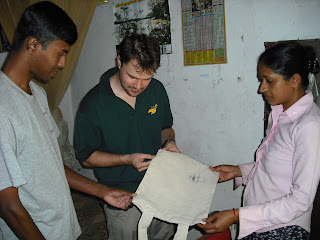
I was able to meet a fishing family that had benefited from the provision of a sewing machine. This lady, with ECO-V’s guidance has been able to produce fabric bags as an environmentally friendly alternative to polythene. These bags are now becoming popular within the village, and are proving to be an important part of upholding the status of the project within the community.


Investigating the handiwork


The foundations for the future community support are being laid through the development of the Friends of Pelicans group. Whilst in Udawalawa I attended a Friends of Pelicans meeting, which was hosted by Harsha. I was able to see how keen these young people were to be involved - another positive sign that the area is in safe hands.


Harsha with some of the Friends of Pelicans


Throughout my stay, I was struck by the level of friendly respect in which the team is held throughout the community, and it was clear that the careful, often slow, steps that have been taken to ensure local support for more eco-friendly activities have been worth the effort.


Walks around the surrounding area gave me opportunities to see the landscape that these local people live in and rely on. The waterways, the paddy fields and the plantations are all delicately reliant on many factors remaining favourable. The community now recognise the importance of saving the pelicans, and a healthy pelican population should mean a healthy wetland system and a more robust resource for the local people.

Surviving on the land can be tough


Of course, being situated on the edge of a national park offered many wildlife viewing opportunities, both inside and outside of the protected area. One morning, we went on safari within the National Park, coming close to countless elephants, saw buffaloes, monkeys, monitors, crocodiles, hornbills, bee-eaters, storks, herons, and spot-billed pelicans. It was breathtaking and unforgettable.

One of many magnificent elephants seen on the safari


Add visits to temples and sites of other cultural interest in the area, a swim in the reservoir, the chance to get to know the project staff better and it all combines to make a very special week - and a valuable insight into the nature of the challenges being faced and met by the Pelican Project team.